If you are getting low-quality, dull, or faded prints, then your sublimation paper might be the reason. This paper plays a critical role in transferring ink onto the substrate and directly affects colour vibrancy, print quality, and the overall result. In this guide, you will learn.
- What is sublimation paper?
- How it works
- Different types of sublimation paper
- How can you choose the right paper for your project?
Whether you are a beginner or an experienced professional, this article will help you achieve better results.
What is Sublimation Paper?
Sublimation paper is a specially coated paper designed to hold sublimation ink and release it efficiently when the right amount of heat is applied. Unlike regular paper, this does not permanently absorb ink. Instead, it holds the ink on its surface, allowing it to convert to gas during heat pressing and form a bond with the substrate. Because of this, sublimation printing is different from traditional printing techniques.
What is Sublimation Paper made of?
Heat transfer papers are made from a variety of raw materials including base papers, polymer films and specialty coatings. The chemical composition of this paper is important in the process of printing. It ensures that the ink is absorbed and then released correctly on the substrate.
The base paper is made from high quality wood pulp, which is then coated with a special layer of polymer film. This film is designed to create a barrier between the ink and paper and prevents ink from smudging or bleeding during printing.
What is the working principle of Sublimation Paper?
This paper works by absorbing the ink and then transferring the artwork on the substrate using required pressure and heat. When the ink is printed on the paper, it appears like an ordinary ink, but when it is exposed to right pressure and heat, it turns into gas and then penetrates to the surface of the substrate creating a bond with it.
What are different types of sublimation paper?
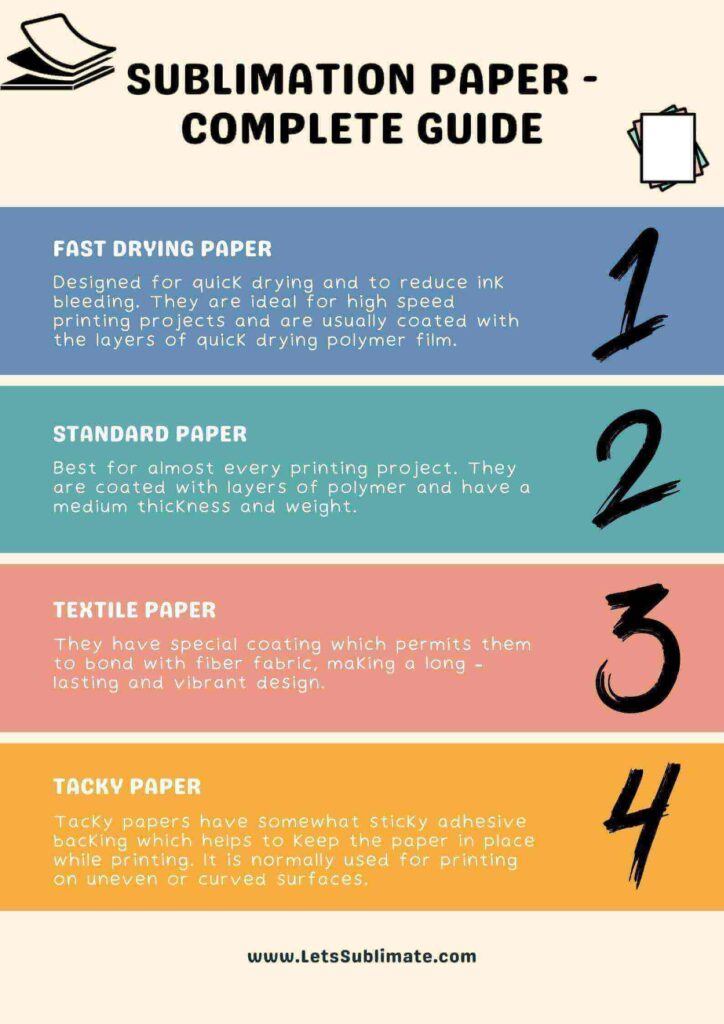
Various sublimation papers are available in the market, having their own unique usage and characteristics. Some common types of paper are.
1. Fast drying paper
These printing papers are designed for quick drying and to reduce ink bleeding. They are ideal for high-speed printing projects and are usually coated with the layers of quick drying polymer film and have a lightweight, thin design.
2. Standard paper
This is the most commonly used heat transfer paper and is best for almost every printing project. These are the papers which I use for almost every project. They are coated with layers of polymer and have a medium thickness and weight.
3. Textile paper
These papers are mainly designed for printing on textiles and fabrics. They have special coating which permits them to bond with fiber fabric, making a long – lasting and vibrant design. This paper is usually heavyweight and thick, which allows it to handle the saturation of ink needed for printing on fabric.
4. Tacky paper
Tacky papers have somewhat sticky adhesive backing which helps to keep the paper in place while printing. It is normally used for printing on uneven or curved surfaces and has a thick and heavy weight.
Note – I recommend considering substrate, printing speed, image quality while selecting the dye – sub paper. It ensures that you achieve the desired result easily.
Quick comparison of Sublimation Paper types
| Type | Best For | Key Feature |
| Fast Drying Paper | High speed printing | Quick ink absorption |
| Standard Paper | Everyday use | Balanced performance |
| Textile Paper | Fabric printing | Better ink bonding |
| Tacky Paper | Hard surfaces & curves | Prevents paper shifting |
How to select the right sublimation paper?
According to my experience there are some important pointers which should not be ignored while selecting the right paper. These are.
1. Pattern
Most designs have light and heavy ink areas, so always select the paper which can carry both of them easily and quickly and does not shift on pressing. I always choose paper with 110 gsm or higher capacity as it gives the best result for my artwork.
2. Capacity
The paper you are using should have higher ability to hold ink. The heavier paper will absorb more moisture. It also doesn’t crumble or curl up once softened.
3.Speed
The type of paper you are choosing is also based on the rate of printing. For the projects which require fast printing, lightweight papers are best, but for individual or slow projects I recommend to use heavy weight or thick paper.
4. Preference
My last recommendation is preference. You should choose the paper as per your preference and project. For example – printing calendars requires low weight paper. Similarly other projects need different kinds of paper. So, you can use your own understanding.
Factors to consider while selecting sublimation paper
In addition to above points you should consider below important factors while selecting the paper for your projects.
1. Compatibility with printer
Many sublimation papers are designed to use with a specific printer. Selecting the wrong paper can result in damaged or poor-quality output. So, make sure the paper is compatible with your printer.
2. Compatibility with substrate
Never ignore the type of substrate you are using. Different substrates need different paper to produce best results.
E.g. metals and ceramics need a printing paper paper with lower release rate for preventing ink smudging or bleeding. On the other hand, fabrics need high release rate paper to make sure that the ink is completely transferred and absorbed in the substrate.
3. Weight and thickness
The weight and thickness of paper are also crucial to consider. Paper with light weight are more cost effective and are easy to handle but paper with high thickness are more durable and are less likely to warp or curl during the printing.
4. Finish of paper
Print quality is highly impacted with paper finish. E.g. Glossy papers produce more colorful and vibrant prints as compared to matte papers. Many times, I use glossy papers as I am so obsessed with vibrant output, but sometimes, when needed I use matte paper also.
Why is sublimation paper sticking? – Troubleshooting tips
If your heat transfer paper is also sticks for longer than usual like mine then it is because of two common reasons
- Temperature is not right
- Overpressing
To fix these issues you need to follow the suggestions below.
- Always make sure that pressure and temperature is optimal.
- To prevent sticking you can use the non sticky spray between substrate and paper.
- You can also use a thin teflon sheet instead of spray.
- Always check the ink and paper specifications beforehand.
Note – If nothing is working, try different temperature and pressure combinations to get the desired result. Sometimes it’s a combination of different heat and pressure which you can get after a few attempts. Make sure to note them for future use.
Common Sublimation Paper problems and fixes
- Ink bleeding – Select fast – drying paper
- Paper sticking – Reduce pressure and temperature
- Ghosting – Use heat resistant tape or tacky paper
- Faded prints – Use high-quality paper or adjust the temperature
Pro Tip – Always test your sublimation paper on a small sample before final printing. Different papers react differently to heat, pressure, and substrates.
Recommended Sublimation Paper for best results
If you are looking for vibrant and consistent prints you should choose right sublimation paper. Here are some recommended options as per my experience.
- A-Sub Sublimation Paper (Best for beginners)
- TexPrint R (Premium quality and professional result)
- Hiipoo Sublimation Paper (Budget-friendly and reliable)
Selecting right paper can instantly improve your print quality and reduce some common issues like ghosting and fading.
If you are facing transfer issues, check my detailed guide on why sublimation is not transferring and how to fix it step by step.
Conclusion
Now you must have got your answer about ‘what is sublimation paper’. By following the above guide, you can easily select the right dye – sub paper for your project and can create amazing artwork. If you want the best results from your sublimation prints, choosing the right paper is very important, along with using the right printer and settings. If you are just getting started, read my complete beginner’s guide to sublimation printing to understand the complete process.
FAQs
Q- Which side of sublimation paper goes up?
Transfer paper has two sides. One is glossy(coated) and another one is normal. Coated side is made to accept the printing ink. Make sure that the coated side of the paper always goes up while printing, else you will not get desired outcome.
Q- What will happen if you use dye – sub paper with a regular printer?
With regular printer you will not be able to use sublimation ink. And if you are using regular ink with your transfer paper then you will not be able to heat press it and get the desired outcome, because regular ink cannot be heat pressed. chances are, you may ruin your heat press machine. so strictly use dye – sub paper, ink and printer for your transfers.
Q- How many times can you use the same sublimation paper?
To keep the design sanctity intact, I always recommend using each paper once. But when the coating is a high release and I have to design some not – so – hard material like a mouse pad, then I reuse the paper multiple times. I always discard it when it starts giving faded results.
Q – Which GSM is best for Sublimation paper?
Generally 100 to 120 GSM(Grams per Square Meter, measuring the paper’s weight, density, and thickness) works best for multiple projects as it balances ink absorption and release.
Q – Can I use regular paper for Sublimation printing?
No, regular paper is not recommended as it absorbs ink and does not release it properly while pressing.